
News
A Practical Guide to Composite Panels for Signs

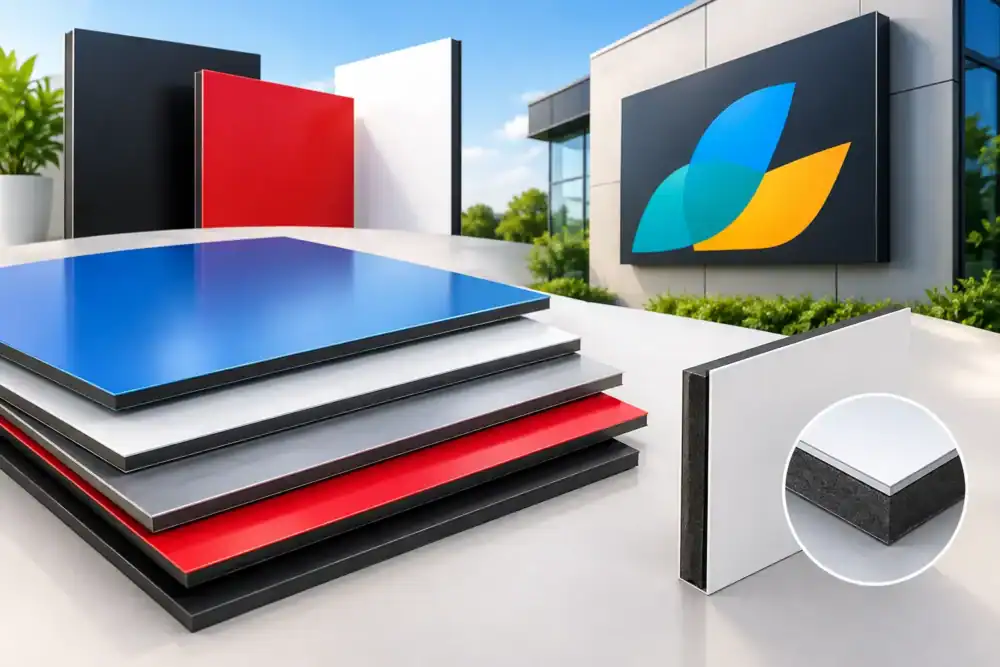
A good site sign has to do more than look sharp on day one. It needs to stay flat, readable and professional through rain, wind, dust, deliveries and daily use. This guide to composite panels explains why aluminium composite material is a trusted choice for durable printed signage, and where it makes commercial sense compared with lighter or lower-cost board options.
What are composite panels?
For signage, composite panels usually means aluminium composite material, often called ACM or referred to by the widely recognised Dibond name. The board is made from a solid core bonded between two thin aluminium faces. That layered construction produces a rigid, lightweight panel with a smooth surface that is ideal for full-colour UV printing.
The result is a professional-grade sign board that is far more stable than corrugated plastic and more weather-resistant than many foam-based alternatives. It is commonly specified for construction signs, property boards, retail fascia panels, directional signage, business signs and branded hoarding graphics.
Composite panels are available in different thicknesses, with 3mm commonly used for printed signs. This offers a practical balance of strength, weight and cost for most everyday applications. Larger boards, exposed locations and specialist installations may call for a thicker material or additional fixing points.
Why choose composite panels for printed signage?
The main advantage is durability. Aluminium composite panels do not absorb water, so they will not swell, soften or delaminate in the way unsuitable materials can. They hold their shape well outdoors and retain a clean, flat appearance when correctly installed.
Their smooth aluminium face also gives printed graphics a crisp finish. UV printing cures directly onto the board surface, producing strong colour, clear text and detailed logos without the need to apply a separate paper print. For a contractor displaying site information or a retailer fitting permanent promotional signage, that clean finish matters.
Composite boards are also easier to handle than their strength suggests. They are light enough for practical transport and fitting, while still feeling substantial once mounted. This makes them useful where several signs need to be installed across a site, estate, venue or retail location.
Cost is part of the decision too. Composite panel signage costs more than temporary Correx boards or some Foamex signs, but it often represents better value where the display will remain in place for months or years. Replacing cheap boards after a difficult winter is rarely the lowest-cost option overall.
Where composite signage works best
Construction and infrastructure sites are one of the strongest uses for composite panels. Entrance boards, health and safety signs, project information panels, directional signs and contractor branding all need to withstand a demanding environment. A rigid printed board is suitable for gates, fencing frames, hoardings, site cabins and external walls, provided the chosen fixings suit the surface.
Retailers and local businesses use composite boards for shop signs, opening-hour panels, menu boards, wayfinding and estate agent displays. The material creates a more permanent impression than a temporary poster or banner, particularly where a sign is viewed close-up by customers.
They are equally effective at commercial premises, business parks, schools, sports grounds and visitor attractions. If the sign needs to carry detailed information, repeated branding or high-resolution imagery, the stable, flat surface helps the design stay legible.
That said, composite is not always the right answer. A short-term event promotion may be better suited to a PVC banner, roller banner or lightweight display board. For a very large hoarding scheme, printed hoarding panels can be planned around the framework and budget. The right material depends on lifespan, location, fixing method and how often the message will change.
Choosing the right panel size and thickness
Start with viewing distance. A small parking notice and a large site entrance board have very different requirements. The further away the sign will be read, the larger the text, logo and overall panel need to be. Trying to fit too much information onto a small board is a design problem, not a printing problem.
For many signs, 3mm aluminium composite board is the standard practical choice. It is sufficiently rigid for wall-mounted signs, directional boards and most construction applications. Bigger panels may need more support, particularly in open or windy locations. A board can be strong in itself but still flex if it is only fixed at the corners.
Custom sizing is valuable because it reduces unnecessary joins and creates a neater result. Where a display needs to cover a large area, multiple panels can be produced to a planned grid, with artwork aligned across the joins. This is commonly used for branded hoardings and large-format site graphics.
Also think about transport before ordering. Oversized boards require suitable access, safe handling and enough space at the fitting location. A panel that is straightforward to install with two people may be more efficient than one very large sheet that needs specialist lifting arrangements.
Printing and artwork: getting the message right
Composite panels are capable of detailed full-colour printing, but the artwork still needs to be built for the job. High-resolution logos, correctly sized images and clear colour values will produce a better result than screenshots, low-quality web graphics or files created at the wrong dimensions.
Construction signage should prioritise clarity over decoration. Site rules, mandatory notices, directional arrows, contact details and emergency information must be easy to identify quickly. Use strong contrast and generous spacing, especially where the board will be viewed from a vehicle or across a yard.
For promotional signs, keep the hierarchy simple. The business name or key offer should be visible first, followed by the action you want the customer to take. A busy sign with five competing messages may be printed perfectly and still fail to do its job.
A free artwork check or proof is particularly useful when ordering a set of panels. It gives you the chance to confirm spelling, dimensions, crop areas and branding before production begins. This is a straightforward way to avoid costly errors, especially when multiple stakeholders have supplied information.
Fitting composite panels securely
The panel must be fixed to a suitable, stable surface. Common options include screws with washers, drilled fixing holes, channel systems, sign frames and adhesive systems designed for the substrate. The best choice depends on whether the board is going onto timber hoarding, brickwork, metal fencing, a post system or an internal wall.
For external signs, use enough fixing points to support the full panel rather than relying only on the corners. Large boards need fixings placed around the perimeter and, where necessary, through the centre to reduce movement in wind. Allowing a small gap between adjacent panels also helps maintain a neat finish and accommodates minor expansion.
Do not assume every site board can be fixed in the same way. A temporary timber hoarding, for example, has different demands from a masonry wall or a steel gate. Check the condition of the mounting surface, assess wind exposure and follow site rules for working at height. For safety-critical or regulated signs, always work to the project specification and applicable requirements.
Weather resistance, fire considerations and maintenance
Aluminium composite signage is built for external use, but no printed sign is entirely maintenance-free. Dirt, traffic film and construction dust can reduce impact over time. A soft cloth, mild detergent and clean water are normally enough for routine cleaning. Avoid abrasive pads, harsh solvents and pressure washing at close range, as these can damage the printed surface or edges.
Outdoor life depends on exposure. A sheltered sign on a building frontage may remain presentable for years, while a board facing coastal weather, heavy traffic or constant sun will need more regular inspection. Check fixings, panel edges and the condition of the printed face as part of normal site maintenance.
Fire performance needs careful attention on construction projects. Not all aluminium composite materials have the same core composition or classification, and a standard printed sign board should not be treated as automatically suitable for every cladding, façade or fire-sensitive application. If a project specification calls for a particular fire rating, confirm the required material before ordering.
When to choose an alternative material
Foamex is a practical option for indoor displays and short-to-medium-term signs where lower weight and cost are priorities. Correx is useful for temporary estate boards, event signs and campaign messaging where a short service life is expected. PVC or mesh banners are often the better solution for fencing, scaffolding and very large promotional graphics.
Composite panel is the stronger choice when you need a rigid, premium-looking sign that will stand up to regular outdoor use. It is particularly effective when the display is permanent enough to justify a material that looks professional long after installation.
For UK businesses that need printed boards quickly, Big Value Banners can produce custom composite panel signs with full-colour UV print, practical sizing options and free design support. The best starting point is simple: decide where the board will be fitted, how long it needs to last and what people must be able to read at a glance. Those three answers will usually point you towards the right panel, the right artwork and a sign that keeps working after the first week on site.


