News
What Makes Banners Fire Retardant? Buyer Guide

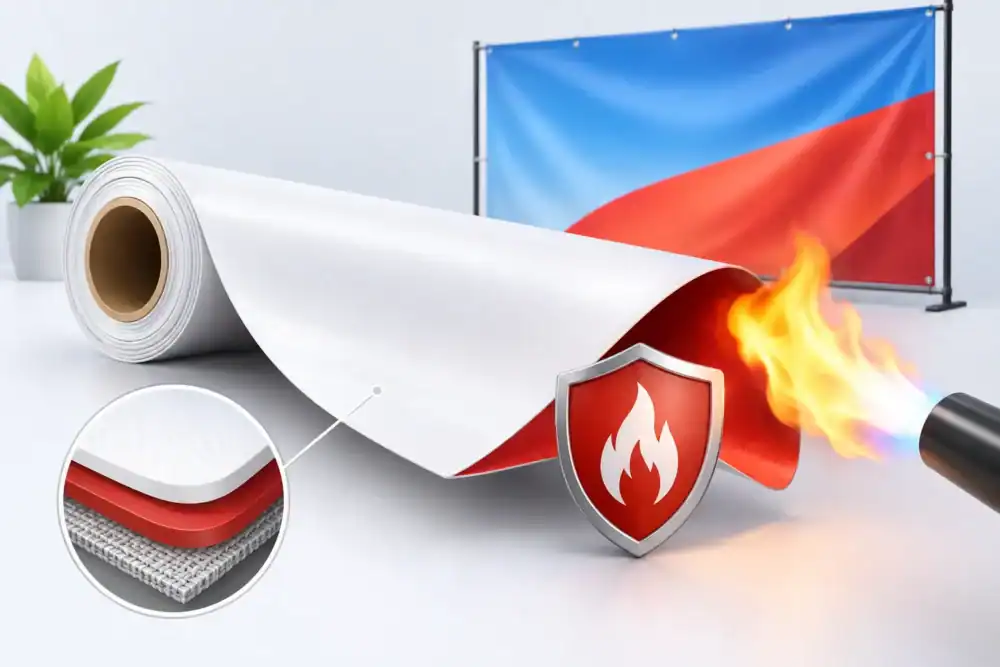
A banner can look identical to a standard printed banner yet perform very differently when exposed to heat or flame. For site managers, event organisers and trade buyers, understanding what makes banners fire retardant helps avoid a costly specification mistake – particularly where banners are installed indoors, in public spaces, at exhibitions or around busy construction projects.
Fire-retardant banner material is designed to resist ignition, slow flame spread and reduce the chance of a small fire becoming a larger one. It is not fireproof, and it should never be treated as a substitute for sensible installation, clear escape routes or site fire controls. The right material depends on where the banner will be used, how it will be fixed and what evidence the venue, principal contractor or local authority requires.
What makes banners fire retardant?
A banner becomes fire retardant through the composition of its base material, the additives used during manufacture, or a specialist surface treatment. In practical terms, flame-retardant PVC is commonly formulated so it is less likely to catch fire and less likely to allow flames to travel quickly across its surface.
Some materials have fire-retardant properties built into the PVC or textile during production. These are often described as inherently flame retardant. Others are treated with a fire-retardant coating after the material is made. Both can be suitable, but they are not automatically equal. The performance can vary according to the product, its weight, finish and intended use.
The most important point is that the claim should relate to the finished printable material, not simply to a raw component. Printing, laminating, sewing, adding hems or applying other finishes can affect how a banner behaves. When a project needs documented compliance, ask for the relevant certification for the actual banner stock being specified.
Fire retardant does not mean fireproof
This distinction matters. A fire-retardant banner is made to limit ignition and flame spread under defined test conditions. Given enough heat, direct flame exposure or time, it can still burn, melt, deform or produce smoke.
PVC banners in particular may soften or melt when exposed to high temperatures. That does not mean they are unsuitable. It means they must be chosen for the environment and installed responsibly. A banner located near a heat source, temporary heater, cooking area, electrical equipment or emergency exit may need a different solution, a different position or approval from the person responsible for fire safety.
For outdoor building sites, the main priorities are often weather resistance, wind loading, secure fixings and clear visibility. For an indoor exhibition hall, retail centre, school, theatre or public venue, fire classification is more likely to be a condition of entry. The same artwork may work across both settings, but the material specification may not.
The standards and certificates buyers should check
There is no single label that covers every fire-retardant banner application. Venues, event organisers and contractors may request different standards depending on the type of display and where it is being installed.
For many UK and European projects, buyers may encounter classifications under BS EN 13501-1, which grades the reaction of construction products to fire. You may also see standards associated with textile displays, including EN 13773, or requirements based on a venue’s own fire-safety policy. Some organisers still refer to older British Standards or use accepted certification lists for exhibition graphics.
The exact class required is not something to guess. Ask the venue or project manager before ordering, especially if a banner is needed for a large public event or a controlled indoor environment. Then request the certificate or test documentation that matches the material and requirement. A general statement that a product is “fire retardant” may not be enough for sign-off.
It is also worth checking the scope of the certificate. Does it cover the material in the format you are ordering? Is it current? Does it apply to printed media, and are there restrictions on ink coverage, coatings or end use? These details can prevent last-minute issues when an exhibition contractor checks graphics at build-up.
PVC, mesh and textile banners: the differences
The banner type affects more than appearance. It influences wind performance, handling, installation and the fire-retardant options available.
Flame-retardant PVC banners
PVC banner remains a popular choice for promotional graphics, site branding and indoor display because it is hard-wearing, cost-effective and produces strong full-colour print. Flame-retardant PVC options are often suitable where a solid banner face is needed and the venue requires supporting certification.
The trade-off is wind. A solid PVC banner can act like a sail on exposed fencing, scaffolding or open elevations. Use suitable fixing points, enough tension and, where required, wind slits or an alternative material. Fire performance does not replace the need to specify a banner that is safe in the weather conditions it will face.
Fire-retardant mesh banners
Mesh banner has small perforations that allow air to pass through. This makes it a practical choice for Heras fencing, construction perimeters, scaffolding and exposed locations where wind load is a concern. The print remains visible from a normal viewing distance, although it will not have the same solid finish as standard PVC.
Not all mesh products carry the same fire classification. If mesh is needed indoors or for a site with a specific requirement, confirm that the chosen mesh stock has the right evidence. Do not assume a flame-retardant solid PVC certificate covers a mesh banner, even if the print and finish look similar.
Textile exhibition displays
Fabric graphics can be an excellent fit for shell schemes, backdrops, tension frames and retail displays. They are lighter to transport, often crease-resistant and can create a premium finish without glare. Many exhibition textiles are supplied with a recognised fire rating, but the standard required still depends on the venue.
Textile is not automatically the best option for every job. A short-term indoor display may benefit from fabric, while a long-running outdoor promotion may be better served by a durable PVC or mesh material. Start with the location, duration and compliance requirement, then select the product.
Printing and finishing can affect performance
The base material does most of the work, but production choices still matter. UV printing is widely used for banners because it delivers sharp colour, durable graphics and a practical finish for commercial use. For a fire-rated job, the printing process and ink system should be compatible with the tested material specification.
Finishing needs similar care. Eyelets, hems, pole pockets and reinforced edges are essential for many installations, particularly on fences and construction sites. However, a bespoke finished banner should be produced in line with the supplier’s stated material guidance. If a venue needs documentation, raise that requirement before artwork approval and production.
Avoid adding untested extras after delivery. Applying an adhesive vinyl, a protective coating, a backing sheet or decorative material could alter the banner’s surface and compromise the evidence supplied. Where compliance matters, keep the product exactly as specified.
How to specify a fire-retardant banner correctly
The quickest way to get the right banner is to give your print supplier the practical detail at the start: where it will be used, whether it is indoor or outdoor, its size, how long it will be displayed, how it will be fixed and any fire standard requested by the venue or client.
If the requirement is unclear, ask the organiser, facilities manager or principal contractor for it in writing. “Fire retardant required” is a useful starting point, but a named standard or minimum classification gives everyone a clearer route to approval. This is particularly valuable for exhibition graphics ordered close to an event date, when a replacement banner can create unnecessary cost and delay.
For construction buyers, consider the whole signage package. A branded mesh fence banner may be right for an exposed perimeter, while safety boards, hoarding panels and directional signs may each need a different substrate. Ordering from one dependable UK production partner makes it easier to keep artwork, sizing, turnaround and material choices under control.
A practical choice for safer displays
The best fire-retardant banner is not simply the one with the strongest-sounding description. It is the banner with a suitable tested material, the correct classification for its location, durable printing and finishing, and a specification that makes sense for wind, visibility and budget.
At Big Value Banners, clear artwork proofs and practical material advice help buyers order with confidence before production begins. Confirm the requirement early, retain the certification with the project paperwork and choose a banner made for the job – that is the simplest route to a display that looks professional and meets the brief.


