News
Floor Vinyl Sticker Printing That Lasts

A floor graphic gets judged in seconds. If it curls at the edges, scuffs after a week or turns slippery under footfall, it reflects badly on the business using it. That is why floor vinyl sticker printing needs more than a good-looking design. It has to perform in real conditions, from busy retail aisles and exhibition halls to receptions, schools and temporary promotional spaces.
For most buyers, the challenge is simple. You want strong print, clear messaging and a finish that stays put without creating problems for staff or visitors. Price matters, but so does durability. Fast dispatch matters, but only if the product arrives ready to do the job properly. Getting that balance right is what separates a cheap sticker from a practical floor graphic.
What floor vinyl sticker printing is designed to do
Floor vinyl graphics are built for surfaces that get walked on, wheeled over and cleaned regularly. That changes the print requirements straight away. A standard self-adhesive vinyl used on a wall or window is not enough for most floor applications because the surface takes much more abrasion and needs a suitable anti-slip finish.
In commercial settings, floor vinyl sticker printing is usually used to direct movement, promote offers, support events or reinforce branding in spaces that already have heavy traffic. Retailers use it for point-of-sale promotions and wayfinding. Event organisers use it to guide visitors through venues. Contractors and site teams may use temporary floor markings in managed indoor areas where clear visual direction helps people move safely.
The practical appeal is obvious. Floor space is already there, and it is often underused. A printed floor graphic turns that area into something useful without adding stands, frames or extra fixtures.
Where floor vinyl graphics work best
The best applications are the ones where people naturally look down or move through a controlled route. Entrances, queueing areas, aisles, foyers, exhibition walkways and showroom floors all make sense. In these spaces, floor graphics can support promotions, mark distancing or direction, highlight departments or create branded zones.
That said, it depends on the environment. Indoor floors are usually the safest option for print longevity and adhesion. Outdoor use can work in some cases, but weather, surface texture and cleaning methods all affect performance. A smooth, sealed floor behaves very differently from rough concrete, block paving or damp external surfaces.
If you are ordering for a public-facing business, it is worth thinking beyond the message itself. A bright promotional decal may look excellent on screen, but if the floor is dark, heavily patterned or constantly wet near an entrance, the finished result may not deliver the clarity or lifespan you expect.
Floor vinyl sticker printing and surface compatibility
One of the biggest reasons floor graphics fail is poor surface matching. Buyers often focus on artwork first, when the floor material is just as important. Vinyl needs a clean, dry and suitable surface to bond well. Tiles, sealed concrete, laminate and some smooth commercial floor finishes are generally straightforward. Uneven surfaces, dusty substrates and textured finishes are more difficult.
This matters because adhesive performance is not one-size-fits-all. A graphic applied to a polished indoor retail floor may stay flat and secure, while the same product on a slightly dusty warehouse walkway could lift early at the edges. That does not always mean the print is poor. It often means the application conditions were wrong for the material chosen.
For trade buyers and facilities teams, that is where expert print support adds value. It helps avoid ordering a product that looks cost-effective on paper but needs replacing too soon.
Why anti-slip finish matters
A floor graphic has to do two jobs at once. It needs to catch attention, and it needs to remain safe under foot traffic. That is why anti-slip protection is not an optional extra for most commercial floor applications. It is a core part of the specification.
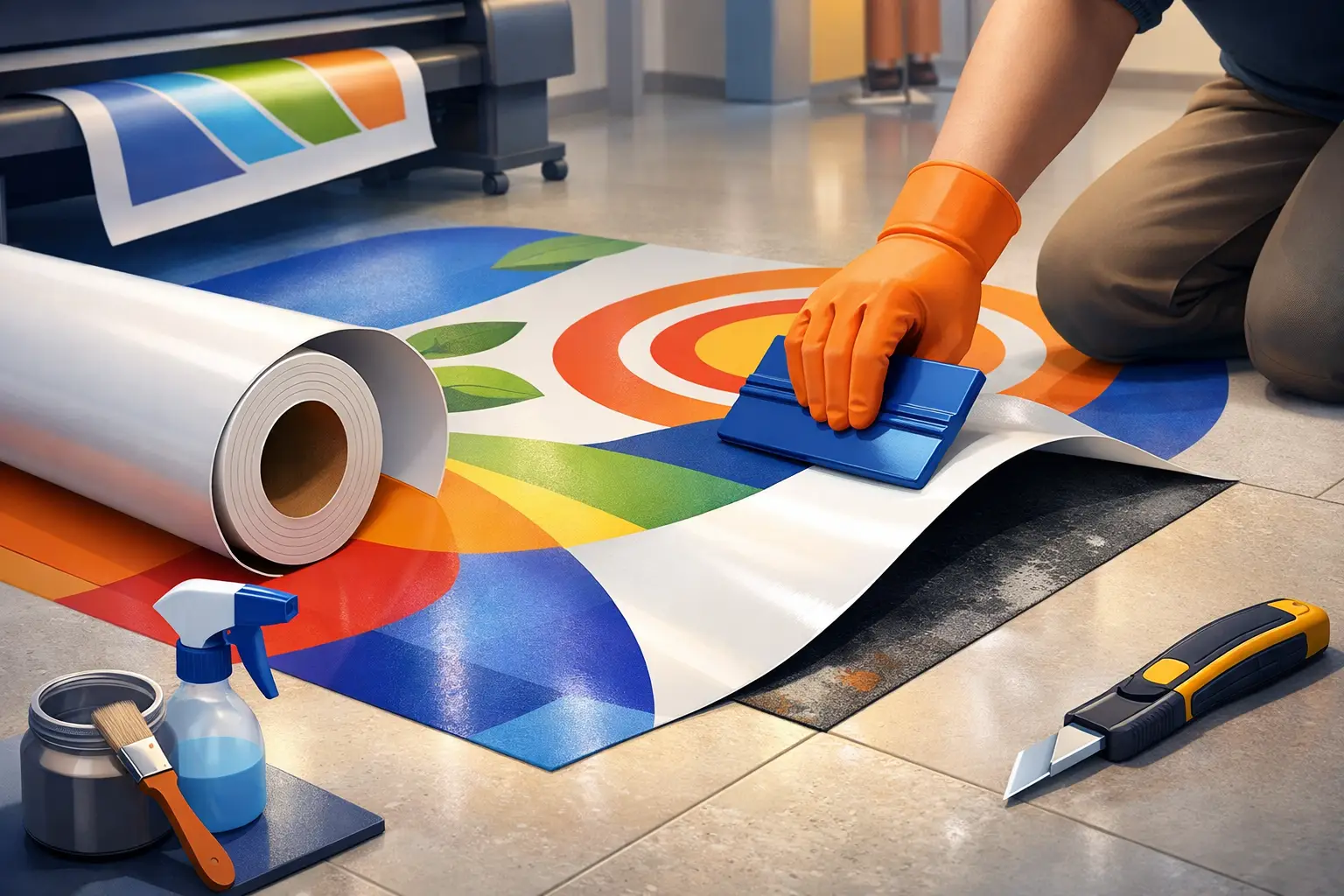
A proper floor graphic system usually combines printed vinyl with a textured overlaminate designed to improve slip resistance and protect the print beneath. Without that layer, the ink can wear quickly and the surface may not be suitable for busy pedestrian areas.
There is a trade-off, though. Heavier protective finishes can slightly soften the sharpness of the printed image compared with an unlaminated surface. For most commercial uses, that is the right trade. A floor sticker is there to work hard, not sit untouched like a poster behind glass.
Print quality still matters on the floor
Durability is essential, but buyers should not treat floor graphics as purely functional. Print quality still affects results. Strong colour, crisp text and high contrast are especially important because people view floor stickers quickly and often at an angle while moving.
That means artwork should be simpler than many wall graphics or exhibition panels. Small text, fine detail and low-contrast colour combinations tend to underperform. A bold directional arrow, a clear promotional offer or a simple branded shape usually works better than a busy layout loaded with information.
For businesses ordering at scale, consistency also matters. If a campaign is rolled out across multiple stores, venues or branded spaces, the colours and finish need to stay uniform. Reliable production and full-colour UV printing help deliver that consistency, especially when repeat orders are part of the plan.
How long should a floor sticker last?
There is no single answer because lifespan depends on traffic levels, cleaning routines, footwear, trolleys and the floor itself. A short-term promotional graphic in a moderate-footfall showroom may look good for a useful campaign period. A sticker placed in a high-traffic supermarket entrance will face a much harder life.
This is where buyers need to be realistic. If the graphic is for a weekend event, the priority may be quick production and easy application. If it is for a month-long retail promotion or a branded route through a venue, durability becomes more important. Paying slightly more for a better-specified product often saves money compared with reprinting or replacing graphics too soon.
It is also worth considering removal. Some floor graphics are intended for temporary campaigns and need to come up cleanly at the end. Others are expected to stay in place for longer periods. The right adhesive balance depends on what happens after installation, not just during it.
Ordering floor vinyl sticker printing for business use
For most commercial buyers, the process should be straightforward. You need the right size, the right shape, suitable artwork and a material specification that matches the floor and the campaign length. If any of those elements are unclear, problems usually show up after installation rather than before.
Custom sizing is often the practical choice because floor spaces are rarely standard. A narrow aisle marker, a circular queue-point decal and a large entrance message all require different formats. That is one reason businesses often prefer to work with a supplier that already handles a broad signage range. It makes it easier to align floor graphics with banners, window vinyls, rigid boards and other display materials in the same campaign.
Free design support and proofs also make a difference here. Floor graphics are harder to judge than flat posters because orientation, viewing angle and surrounding floor colour all affect readability. A proof gives buyers a chance to spot issues before print goes ahead.
When low price is a good deal and when it is not
Value matters, especially for multi-site rollouts, event branding and promotional campaigns with tight budgets. But low price only works if the product performs for the required period. If a cheap floor sticker lifts, fades or wears too early, the replacement cost and labour quickly remove any saving.
A better way to judge value is to look at the full picture: print quality, anti-slip protection, expected lifespan, dispatch speed and whether the supplier can support artwork and specification decisions. High quality at low prices is not about buying the thinnest material available. It is about getting a product fit for purpose without paying over the odds.
For UK businesses, local production also has practical benefits. Faster dispatch, easier communication and more dependable lead times help when campaigns are working to fixed launch dates. That is particularly useful for retailers, exhibitors and site teams who cannot afford delays.
Choosing a supplier for floor vinyl sticker printing
A dependable print partner should make the buying decision easier, not more complicated. Clear product guidance, honest turnaround times and support with artwork are all signs that the job will be handled properly. If the supplier already understands commercial signage, they are more likely to ask the right questions about use, surface type and durability before production starts.
That is the advantage of working with an established UK print company such as Big Value Banners. The focus is not just on producing graphics that look good when they leave the press. It is on supplying practical signage that performs in the real world, with competitive pricing, fast dispatch and support that helps buyers get it right first time.
The smartest floor graphics are rarely the most complicated. They are the ones that stay clear, stay safe and stay in place for as long as the job demands.


