News
Mesh Banners vs PVC Banners for UK Sites

A banner that looks excellent in the artwork proof can become a problem once it is fitted to exposed fencing. That is why the choice between mesh banners vs PVC banners should start with where the banner will be used, how much wind it will face and what it needs to achieve. For a busy construction site, event perimeter or retail promotion, the right material helps your message stay visible while keeping installation practical and costs under control.
Both options deliver sharp full-colour UV print, custom sizing and strong outdoor performance. The difference is in how the material handles airflow, light, viewing distance and day-to-day site conditions.
Mesh banners vs PVC banners: the main difference
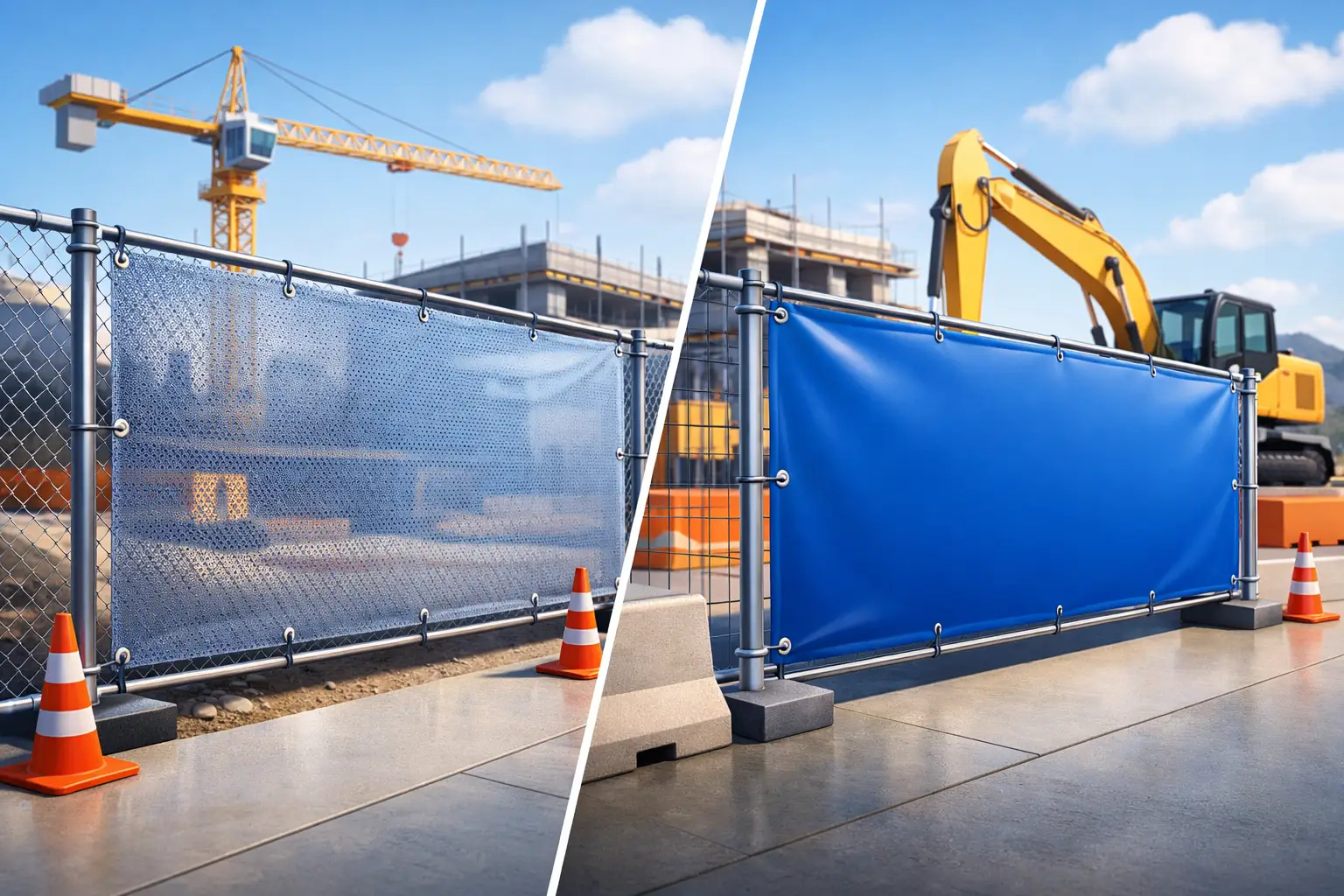
PVC banners are made from solid banner vinyl. They have a smooth, non-perforated surface that gives graphics maximum visual impact, particularly at close range. They are a dependable choice for promotions, shopfronts, event entrances, temporary advertising and sheltered site locations.
Mesh banners have tiny, evenly spaced perforations across the material. These holes allow air to pass through, reducing wind pressure on fencing, scaffolding and frames. From a normal viewing distance, the printed design remains clear, but the material is built for places where a solid banner could catch the wind like a sail.
Put simply, choose mesh when wind loading is the main concern. Choose PVC when the strongest, most solid-looking print is the priority and the location is suitably sheltered.
When a mesh banner is the better option
Mesh is the practical choice for temporary Heras fencing, scaffolding wraps, perimeter fencing and exposed outdoor sites. Construction projects often have long runs of fencing in open areas, where wind can put repeated strain on banner edges, eyelets, cable ties and the fence panels themselves. Airflow through the mesh reduces that pressure.
This does not mean mesh banners are only for construction. They work well around festivals, sports grounds, car parks, redevelopment schemes and outdoor events where branding needs to cover a large perimeter without creating unnecessary wind resistance. They are especially useful where the banner will remain in place for weeks or months through changeable British weather.
The trade-off is visual density. Because mesh contains perforations, it will not have quite the same solid finish as PVC at very close range. Fine text, small logos and delicate photographic detail can lose some definition if the design is not prepared with the material in mind. For most perimeter banners viewed from several metres away, this is rarely an issue. Large logos, bold type and high-contrast graphics perform extremely well.
Best uses for mesh banners
Use mesh for high-wind or open locations, including fencing beside main roads, elevated scaffold areas, exposed building sites and event perimeters. It is also a sensible choice when a long line of banners needs to be installed quickly across Heras panels, as the reduced wind load makes the finished run more manageable.
For site branding, consider repeating a logo and key message rather than relying on one small design placed in the centre. Repetition ensures the branding is still visible where fence panels overlap, gates interrupt the run or parts of the banner are obscured by site activity.
When PVC banners deliver better value
PVC banners are the go-to option when impact matters most. The solid surface produces rich colour, strong contrast and crisp text, making it ideal for offers, directional messages, event branding and promotions that people will read at close range.
A PVC banner can be a cost-effective advertising tool for a shop exterior, market stall, school event, trade counter, indoor venue, building frontage or sheltered fence line. If the banner is intended to promote a time-sensitive offer, announce an opening, display contact details or direct visitors to an entrance, the extra clarity can make a real difference.
They are also well suited to designs containing product images, detailed logos, QR codes or small print. A QR code should always be tested before production, but PVC gives it the best chance of scanning reliably because there are no perforations breaking up the code.
PVC is still a durable outdoor material, but fixing matters. On an exposed site, wind does not only affect the banner. It can strain the eyelets, cable ties, fence panel and support structure. A large PVC banner on open Heras fencing may not be the safest or most sensible material choice, even if the print design looks better on paper.
Best uses for PVC banners
PVC is a strong fit for promotional banners, retail displays, event entrances, wall-mounted signs, indoor branding and protected outdoor locations. It is also a practical choice for short-term campaigns where high-impact print is needed fast and exposure to strong wind is limited.
If your banner is being mounted to a wall, fixed inside an exhibition space or used behind a reception desk, PVC normally gives the cleaner, more polished appearance. For construction sites, it can work well on hoardings, gates or fixed sections where the banner is supported by a solid background rather than open fencing.
Print quality, readability and design choices
Both mesh and PVC can carry vivid full-colour print, but good banner design should reflect the material and location. The larger the viewing distance, the bigger and simpler your message should be. A passing motorist, site visitor or pedestrian does not need a paragraph – they need a recognisable brand, a clear service and a way to act.
For mesh, use bold fonts, strong colour contrast and generous spacing. Avoid placing vital detail close to eyelets or at the outer edge, where folds and fixings can affect visibility. Keep phone numbers, web addresses and calls to action large enough to read from the expected distance.
For PVC, you have more freedom to use fine detail, but restraint still pays off. A banner overloaded with copy is difficult to read, regardless of print quality. One main message, supporting information and a clear logo will usually outperform a crowded layout.
A free design proof is valuable for both materials. It allows you to check scale, artwork position, eyelet placement and whether the message works across the exact finished size before production starts.
Durability, installation and finishing
Neither material should be chosen on material alone. The final result depends on correct sizing, finishing and installation. A banner needs enough fixing points to spread the load evenly, particularly on fencing and scaffold. Eyelets are commonly used with cable ties or bungee cords, while hems add strength around the edge for demanding outdoor applications.
Avoid pulling a banner excessively tight. It may look neat at first, but over-tensioning can put unnecessary stress on the edges and fixings. Secure it evenly, check it after the first period of bad weather and replace damaged ties promptly. On construction sites, include banner checks within normal fence and perimeter inspections.
For long fence runs, ordering banners to suit standard panel dimensions can make fitting quicker and reduce wasted material. It also gives your site a more consistent appearance. If access gates are involved, separate gate banners prevent staff from having to remove a full-length graphic every time vehicles enter or leave.
Cost: look beyond the purchase price
Mesh and PVC banner prices vary by size, quantity, finishing and artwork requirements. PVC can be the best-value choice for a straightforward promotion in a low-wind location because it delivers maximum print impact at a competitive price. Mesh can represent better value on exposed sites because it is designed for the conditions and may reduce the risk of wind-related damage or repeated replacement.
The cheapest banner is not always the lowest-cost option once installation time, site safety and expected lifespan are considered. A material that suits the environment first time can save disruption later.
Which banner should you order?
Choose mesh if your banner will sit on open Heras fencing, scaffolding or another wind-exposed structure. Choose PVC if you need the most solid, high-definition appearance for a sheltered outdoor position, wall, hoarding, shopfront or indoor display.
If the location falls somewhere between the two, assess the exposure honestly. A banner on a fence beside an open field faces very different conditions from one in a sheltered town-centre yard. The team at Big Value Banners can help check sizes, artwork and finishing so you can order a banner that is ready for the job, not just ready for print.
The best choice is the one that keeps your message clear, your installation secure and your site looking professional from the first day to the last.


