
News
Roller Banners for Events, Retail and Displays

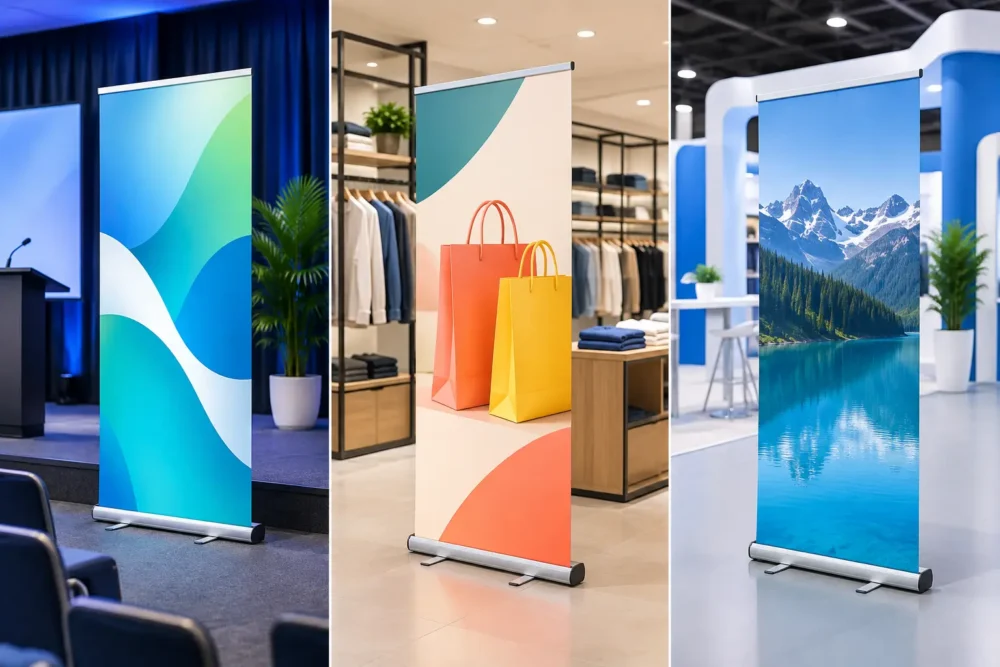
A busy exhibition floor gives people only seconds to understand who you are and what you offer. Roller banners put your message at eye level, create a professional backdrop and pack down quickly when the day is done. For businesses that need high-impact display without the cost, storage demands or set-up time of a full stand, they are one of the most practical print products available.
They work just as well beyond exhibitions. Use them in reception areas, showrooms, retail promotions, training rooms, trade counters, open days and temporary sales spaces. The right banner gives your team a clear, portable way to present branding, offers or key information wherever customers need to see it.
Why roller banners remain a smart display choice
The main benefit is simplicity. The printed graphic is fixed inside an aluminium cassette and rolls out in seconds. A support pole holds it upright, then everything packs back into its carry case for transport and storage. There are no complicated fittings, no wall fixings and no specialist installation required.
That matters when staff are travelling between venues, setting up before doors open or working with limited floor space. A roller banner can be carried in a car, placed where it will be noticed and moved if the layout changes. It is a reliable choice for one-off promotions as well as repeat use throughout the year.
Roller banners also provide excellent value because the print area is large relative to the footprint. A standard unit typically gives you around 800mm of width and 2,000mm of height, enough space for a strong headline, logo, key benefits and a clear call to action. Several banners placed together can create the visual effect of a much larger branded wall.
However, they are not designed to replace every display format. If your message needs to be read from a long distance outdoors, flags, PVC banners or rigid signage may be the better option. If you need an enclosed exhibition shell scheme or a large media wall, a textile display may suit the job more effectively. Choosing the format around the location and purpose avoids wasted budget.
Choosing the right roller banner size and base
Standard roller banners are the most popular choice for good reason. They are economical, easy to transport and ideal for regular indoor use. An 800mm or 850mm-wide banner fits comfortably beside a table, at a doorway or within a shell-scheme stand without taking over the space.
Wider banners make a stronger visual statement. They are useful behind a reception desk, as a photo backdrop, in a retail window or where a single product image needs room to breathe. A wider print is not automatically better, though. In a narrow stand, an oversized banner can block access and make the display feel crowded.
The base is another practical consideration. A standard aluminium base is a dependable choice for most indoor campaigns. Premium or reinforced bases offer a more substantial appearance and may be preferable where the banner will be used frequently at client-facing events. For outdoor use, standard roller banners should be treated with caution. Wind, uneven ground and rain can quickly affect both stability and print life, so purpose-made outdoor display products are usually the safer investment.
Think about where the banner will travel, how often it will be assembled and who will handle it. A low-cost unit can be ideal for a short campaign or occasional event. For a sales team using the display every week, paying more for a sturdier mechanism and carry case is often better value over time.
One banner or a coordinated set?
A single banner is effective for a simple message, such as promoting a service, highlighting a seasonal offer or directing visitors to a stand. A pair of matching banners can frame an entrance or create a more balanced exhibition layout. Three or more banners work particularly well when each has a defined role: one introduces the brand, one explains the offer and one gives contact details or a call to action.
Avoid repeating the same full design across every unit unless they will be seen separately. When banners stand side by side, they should work together as one display rather than compete for attention.
Designing roller banners people can read quickly
A roller banner is not a brochure. Visitors will often see it while walking past, speaking to colleagues or scanning a crowded room. The design needs to communicate the main point before anyone stops to study it.
Start with one clear message. It might be a service promise, a product category, a launch offer or a short statement of what your business does. Place the logo and headline high enough to be seen above tables and people, then support them with a small amount of useful detail. A large product image can add impact, provided it is sharp and relevant.
Keep the lower section for secondary information. It may be partly hidden by bags, furniture or passing visitors, so it is not the best place for your logo, phone number or the only call to action. Small text, lengthy paragraphs and crowded feature lists are common mistakes. If a customer needs to stand directly in front of the banner to read it, the message is doing too much.
Colour contrast is equally important. Dark text on a pale background, or pale text on a dark background, usually reads best from a distance. Brand colours should be used confidently, but not at the expense of legibility. A free proof is useful here because it allows you to check scale, wording and layout before print production begins.
For print files, use high-resolution images and supply artwork at the correct finished size where possible. Blurry logos, screenshots and small web images may look acceptable on screen but will not produce the crisp result expected from large-format printing. If you do not have finished artwork, professional design support can turn a logo, message and a few images into a display that looks properly considered.
Getting the most from your display budget
The best value roller banner is not always the lowest-priced option. Consider the full job: print quality, cassette strength, carry case, artwork checking, dispatch time and how many times the display needs to be used. A banner that arrives quickly but looks weak under exhibition lighting will not support your brand. Equally, there is little reason to specify a premium exhibition unit for a single, low-footfall promotion.
Ordering several display items together can make event preparation easier. Roller banners pair well with printed tablecloths, flags, PVC banners, flyers, boards and vinyl graphics, depending on the venue. Using the same headline, colours and imagery across each item creates a more professional presence than treating every product as a separate campaign.
Plan delivery around the event date rather than leaving the order until the final week. This gives time to approve the proof, check the finished banners on arrival and make any adjustments before they are needed. Fast dispatch is valuable, but a little preparation protects against last-minute artwork changes and venue requirements.
Looking after roller banners between events
A roller banner can stay presentable for repeated use when it is handled correctly. Extend and retract the graphic steadily rather than letting it snap back into the cassette. Make sure the support pole is fitted securely before releasing the banner fully, and pack it away only when the print is clean and dry.
Store the unit in its carry case, ideally in a dry place away from extreme heat or heavy items that could damage the cassette. If the banner has been used near food, high footfall areas or a building entrance, wipe the base and case before storage. The graphic itself should only be cleaned carefully with a soft, non-abrasive cloth where needed.
Before each event, do a quick set-up check. Confirm the pole sections connect properly, the print retracts smoothly and the design still reflects current contact details, offers and branding. An outdated phone number or expired promotion can undermine an otherwise excellent display.
A well-designed roller banner earns its place because it makes promotion easier. Choose the right width, keep the message focused and buy for the level of use you genuinely expect. With high-quality print, a practical base and a clear proof process, Big Value Banners can help turn a small floor space into a display that gets noticed.


