News
Scaffolding Banners for Building Sites That Work

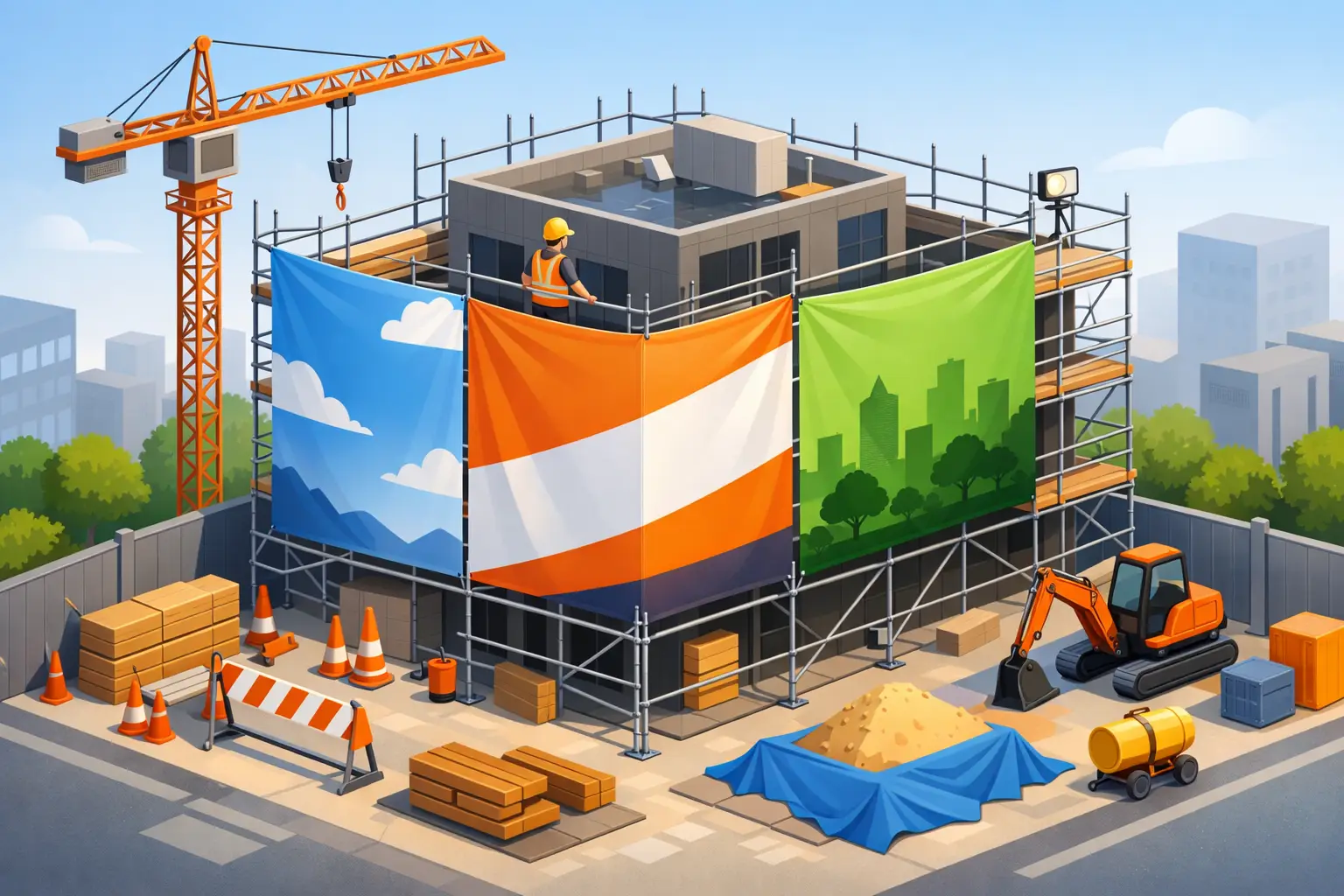
A scaffolded elevation is one of the largest advertising spaces on a live project. Left blank, it does nothing for the contractor, developer or client. Used properly, scaffolding banners for building sites turn that temporary structure into clear project branding, public information and a more professional site boundary.
The right banner needs to do more than look good on day one. It must suit the wind exposure, scaffold layout, viewing distance and duration of the job. It must also be specified with practical fixing points and messaging that remains readable from the pavement, road or neighbouring properties. Getting those details right saves time on site and avoids replacing unsuitable banners halfway through a build.
Why scaffolding banners earn their place on site
Construction work is highly visible, particularly in town centres, retail areas and residential streets. A printed banner helps control that visibility. It can present the contractor’s name, developer identity, contact details, scheme branding or a simple message about what is being built.
For many firms, that visibility has a direct commercial benefit. Existing clients see a professional, well-managed project; passing prospects see the scale of work being delivered; and subcontractors can identify the site quickly. For housebuilders, property developers and regeneration teams, banners can also keep the public informed without relying on temporary paper notices that quickly deteriorate outdoors.
There is a practical benefit too. Branded scaffold sheeting and banners help make a site look organised while work is underway. That matters when the project sits next to occupied homes, trading businesses or public-facing premises. A clean, full-colour installation gives a far better impression than loose, mismatched signage tied to scaffold tubes.
That said, banners are not a replacement for required health and safety signs, emergency information or statutory notices. Keep essential safety messaging clear, correctly positioned and supplied in the appropriate format. Promotional banners should support site presentation, not compete with critical information.
Mesh or PVC: choosing the right material
The material choice is usually the most important decision. It depends on exposure, installation position and the amount of wind likely to pass through the scaffold.
Mesh banners for exposed elevations
Mesh scaffolding banners are perforated, allowing air to travel through the material. This reduces wind loading compared with a solid banner, making mesh the sensible option for open elevations, higher levels and sites with regular wind exposure. The small perforations are noticeable close up, but printed graphics remain clear at normal viewing distances.
Mesh is also a strong choice where a banner covers a large area. It provides an impressive branded finish without creating the sail effect associated with solid materials. For long-running projects, this balance of visibility and practical performance is often exactly what a contractor needs.
PVC banners for sheltered locations
PVC banners provide a solid, high-impact print surface with rich colour and sharper detail at close range. They work well on lower-level scaffold sections, internal site areas, gates and more sheltered positions. They are particularly effective for contact details, logos, campaign graphics and messages that pedestrians will read from nearby.
The trade-off is wind. A full solid PVC banner catches more air, so it should not be used across a large exposed scaffold face without advice from the scaffold contractor or site team. The mounting method, banner size and local conditions all matter.
Get the size and layout right first
A banner can be printed to custom dimensions, but bigger is not automatically better. The best size follows the scaffold bay layout and the viewing point. A banner spanning awkwardly across rails, lifts or access routes can look untidy and become harder to secure correctly.
Before ordering, measure the usable area rather than the total scaffold width. Allow for tubes, handrails, toe boards, ladder access, sheeting and any section that needs to remain clear for operations. If banners are being fitted across several bays, consider whether separate panels will be easier to install, remove and replace than one oversized sheet.
For graphics, keep the key message large. A company name, project title or development logo should be visible in seconds. Telephone numbers, web addresses and detailed copy have their place, but should not dominate the design. If the banner will be viewed from a road, a driver or passer-by needs to understand it quickly.
A simple hierarchy works best: logo or project name first, a short supporting message second, then contact information where needed. Avoid placing vital text too close to the edges, eyelets or scaffold poles. Those areas are likely to be obscured once the banner is tensioned into place.
Design for a working construction environment
Building sites are dusty, busy and constantly changing. Banner artwork should be designed for that environment, not like a brochure page. High-contrast colours and bold typography offer better distance visibility than fine type, pale backgrounds or complicated graphics.
If your brand has set colours and logo rules, use them consistently across scaffold banners, hoarding panels, site boards and gate signage. That creates a more polished site presence and makes it easier to order additional signs as the project develops.
Useful content can include the principal contractor, project team, development name, completion messaging, sales or lettings details, and local liaison contact information. On public-facing schemes, a considerate message about working hours or project updates can help set expectations with neighbours. Keep the tone factual and positive.
At Big Value Banners, free design support and proofs help buyers check proportions, positioning and print readiness before production. This is especially useful when adapting an existing logo or campaign artwork to an unusual scaffold size.
Fixings matter as much as the print
A high-quality banner still needs correct installation. Eyelets should be positioned to suit the chosen banner size and fixing points, while cable ties or suitable bungee fixings need to hold the material securely without excessive strain. Over-tightening can damage eyelets or create unnecessary tension; under-tightening allows the banner to flap, wear and look poor.
Check the banner after installation and as part of regular site inspections. Weather, scaffold adjustments and day-to-day activity can affect tension. Replace damaged ties promptly and make sure loose corners do not create a snagging risk.
For a reliable order and installation process, confirm these points before artwork is approved:
- the measured printable area and whether the banner spans one or several scaffold bays;
- whether the location is exposed enough to require wind-permeable mesh;
- the direction and distance from which the banner will be viewed;
- the required eyelet spacing and planned fixing method;
- the exact logos, wording and contact details to be printed.
This short check avoids the most common issues: an undersized banner, unreadable text, unsuitable material or fixings that do not align with the scaffold structure.
Plan banners around the project programme
Scaffold banners are most effective when they are considered before the scaffold goes up, not after. Early planning gives the site manager time to choose locations, obtain approved artwork and coordinate installation with the scaffold contractor. It also means the banner can be displayed from the first visible stage of the project.
For phased developments, think beyond one elevation. Gate banners can identify the site entrance, mesh panels can cover exposed scaffold sections, and hoarding graphics can carry the same branding at ground level. Ordering these items together creates consistency and can simplify procurement for busy project teams.
Fast dispatch is valuable when a project date moves forward or a client requests additional branding at short notice. Even so, do not let speed replace a final artwork and measurement check. A correctly specified banner delivered quickly is useful; a rushed banner that does not fit is simply another site problem to solve.
Make the site look as professional as the work
Scaffolding is temporary, but the impression it creates can last. A well-designed, correctly specified banner shows that the contractor or developer has considered the public-facing side of the build as carefully as the work behind the scaffold.
Choose material for the conditions, design for the viewing distance and plan the fixing points before print. With those basics in place, your scaffold can carry clear, durable branding from first lift to final handover.


