News
What Is Mesh Banner Material and When to Use It?

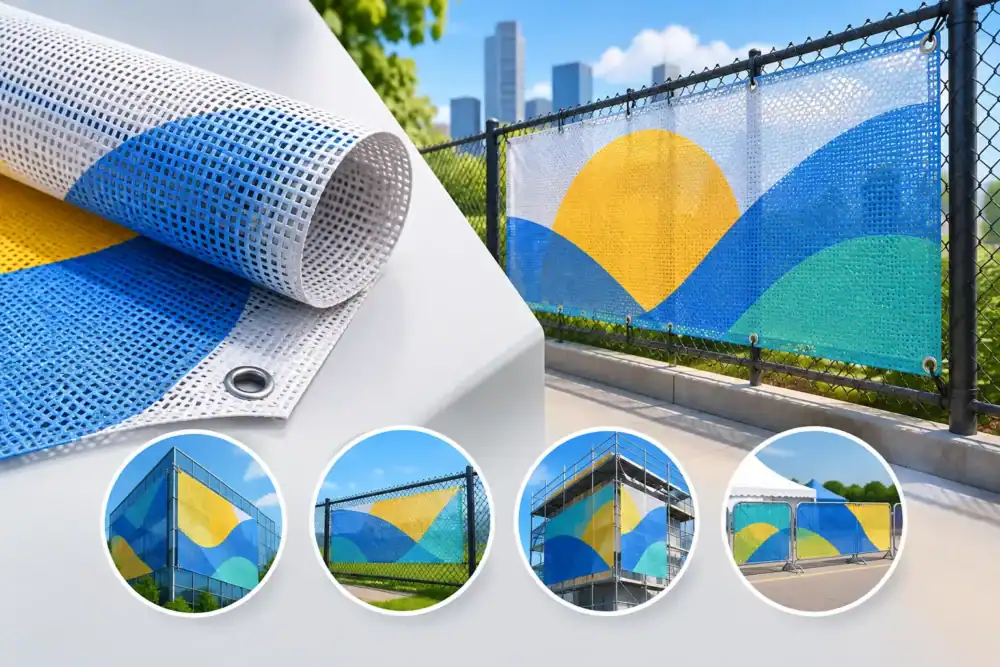
A banner fixed to temporary fencing can look excellent at 8am and be straining at its eyelets by the first strong afternoon gust. That is the problem mesh is designed to solve. So, what is mesh banner material? It is a perforated PVC banner fabric that lets air pass through the printed surface, reducing wind pressure while still providing clear, full-colour branding.
For construction sites, outdoor events, roadside promotions and Heras fencing, mesh banner material is often the practical choice. It gives businesses a large, highly visible advertising area without creating the same sail effect as solid PVC. The result is a display that is better suited to exposed locations, easier to manage over long fence runs and still capable of delivering sharp, attention-grabbing graphics.
What is mesh banner material made from?
Mesh banner material is usually manufactured from PVC-coated polyester. Its defining feature is the pattern of small holes across the fabric. These perforations allow a proportion of wind to pass through rather than pushing directly against the banner face.
The material is supplied in rolls for large-format printing and is commonly finished with hems and eyelets for fitting. At Big Value Banners, mesh is printed in full colour using UV print technology, producing a durable finish suitable for outdoor use. The print sits cleanly across the material, while the perforations remain open enough to relieve pressure in windy conditions.
From close range, the holes are visible. From normal viewing distance, the printed message remains clear. That makes mesh especially effective for site perimeters, where people tend to view the banner from a pavement, road or neighbouring property rather than a few centimetres away.
Mesh versus solid PVC banner vinyl
Standard PVC banner vinyl has a solid face. It is a strong, versatile option for shopfront promotions, indoor displays, shorter outdoor campaigns and locations with limited wind exposure. Because there are no perforations, colours can appear slightly richer and fine artwork may look crisper at very close range.
Mesh trades a small amount of that close-up solidity for better airflow. On a long run of Heras fencing or scaffolding, this is usually a worthwhile trade. A solid banner catches more wind, putting greater load on the banner, ties, fence panels and fixings. Mesh reduces that load, although it does not remove it altogether.
The right choice depends on the location. If a banner will be installed against a solid wall or inside an exhibition hall, standard PVC may be the better-value option. If it will span temporary fencing on an open building site, mesh is normally the safer and more practical material.
Why mesh banners work well on construction sites
Construction projects need signage that works hard. Site fencing often sits in exposed areas for weeks or months, and it can provide hundreds of metres of valuable branding space. Mesh banners turn that perimeter into a professional display for contractors, developers, architects, suppliers and safety messaging.
Their main benefit is wind permeability. Air passing through the material reduces the force acting on each panel. This can help minimise flapping and strain, particularly when banners are installed with suitable spacing and secure fixings.
Mesh also gives a less enclosed visual effect than a solid banner. On some projects, that is useful where light and partial visibility through the fence need to be retained. It can soften the appearance of a busy site while covering untidy fencing and keeping the brand, project details or directional information clearly visible.
For procurement teams, there is another practical benefit: custom-sized mesh banners can be ordered to suit individual fence panels, gates, scaffold sections or longer hoarding runs. This avoids unnecessary overlaps, makes installation tidier and helps the finished site look organised from day one.
Common uses for printed mesh banner material
Mesh is not limited to building sites. It is a dependable outdoor display material wherever wind is likely to be a factor and a large printed area is needed.
It is regularly used for Heras fence banners around construction, infrastructure and regeneration schemes. It is also suitable for scaffold wraps, crowd-control barriers, sports grounds, festivals, outdoor retail promotions and event perimeters. Estate agents and developers may use it around vacant land or new-build schemes, while local authorities and contractors use it for public-facing project information.
For a campaign that needs to cover multiple fence panels, repeat artwork can be highly effective. A logo, contact number, development name or key safety message repeated consistently across the run remains readable even when only part of the perimeter is in view. For event branding, a bold logo and simple colour scheme usually performs better than artwork packed with small text.
When mesh is not the best option
Mesh is highly capable, but it is not the answer to every banner brief. If the job relies on tiny text, detailed photography or viewing from very close range, a solid PVC banner or rigid sign board may offer a cleaner result. The perforated structure can make very fine details appear less defined than they would on a smooth, solid surface.
It is also not a substitute for correct installation. A mesh banner can still be damaged if it is fitted loosely, attached with too few ties or installed on unstable fencing. Strong winds affect the complete setup, not just the printed material. Fence stabilisers, correctly positioned couplers and suitable cable ties all matter.
If privacy is the priority, mesh may not provide enough screening because it allows some visibility through the surface. In that case, a solid banner, hoarding panel or another opaque site-screening solution is likely to be more appropriate.
Choosing the right mesh banner for your site
Start with the location. Consider how exposed the fence line is, how long the banner will remain in place and whether it will be fixed to Heras panels, scaffolding or another framework. A sheltered town-centre frontage has different demands from an open development site near the coast or alongside a major road.
Then consider the viewing distance. For passing traffic and pedestrians, clear branding, a short message and strong contrast will usually outperform a detailed layout. Keep phone numbers, web addresses and essential project information large enough to read at the expected distance. Your logo should have room to breathe rather than competing with too many messages.
Size and finishing should be specified for the installation method. Eyelets allow banners to be tied securely to fence panels or scaffold frames, while reinforced hems add strength around the edges. Ask for a proof before production so dimensions, artwork position and important information can be checked before print.
For large schemes, plan the whole perimeter rather than ordering panel by panel without a layout. Decide where gates, access points, sightlines and key public approaches are located. This helps place the strongest branding where it will be seen most and prevents important text being obscured by fence posts, joins or access barriers.
Installation tips that protect your investment
A good-quality mesh banner needs equally good fitting. Position it flat against the framework and use fixings around the perimeter at regular intervals. Do not rely on a few ties at the corners, as this concentrates stress and allows the centre of the banner to move in the wind.
Use suitable cable ties or banner bungees based on the framework and conditions, and check the installation after periods of high wind. On temporary fencing, make sure the panels themselves are properly supported and weighted where required. A banner can only perform as well as the structure holding it.
Avoid pulling the material excessively tight. The aim is a neat, secure fit with even tension, not a surface stretched to its limit. Allow for the practical realities of temporary fencing, particularly on uneven ground or long perimeter runs.
Get a practical outdoor banner solution
Mesh banner material is a straightforward answer to a common outdoor signage problem: how to promote a project or protect a site perimeter without turning every fence panel into a wind-catching surface. It offers visible full-colour print, practical airflow and a professional finish for commercial environments where ordinary banners may be under greater strain.
For the best result, match the material to the site, keep the artwork clear and make installation part of the plan. A correctly sized, well-fitted mesh banner can keep your branding working hard from the first day on site to the final handover.


