
News
What Size Scaffold Banner Is Best for Your Site?

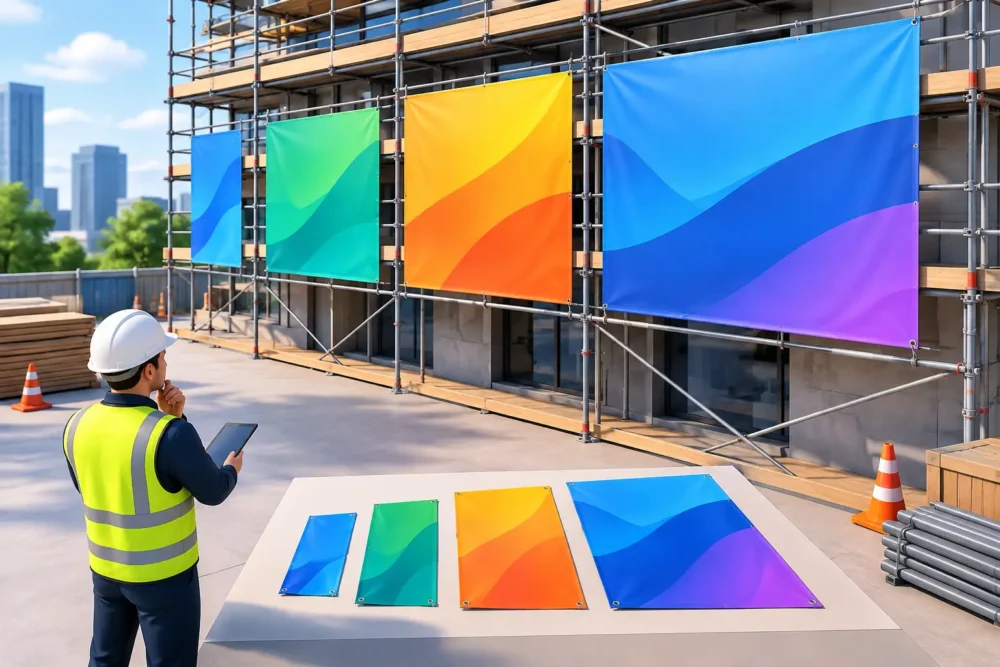
A scaffold banner that is too small can look lost against a busy frontage. One that is too large may crease, obscure access, catch the wind or become difficult to fix safely. When deciding what size scaffold banner to order, start with the actual scaffold bay dimensions, then allow for the message, viewing distance and available fixing points.
For most UK construction sites, the best result comes from a banner sized to fit one or more scaffold bays cleanly, rather than forcing a standard rectangle onto an awkward frame. A measured, made-to-size banner presents your contractor, development or safety message clearly and gives the site a more professional appearance from day one.
What size scaffold banner works for standard bays?
A typical scaffold bay is often around 2.5 metres wide, although this varies by scaffold design, site layout and access requirements. That makes 2.5m-wide banners a popular choice for single-bay branding. Common practical sizes include 2.5m x 1m, 2.5m x 1.5m and 2.5m x 2m.
The right height depends on what sits behind the banner and where it is fixed. A 1m-high banner is usually enough for a company name, logo, phone number and simple site message. At 1.5m or 2m high, there is more room for developer branding, a project visual, multiple logos or a bolder advertising layout visible from across the road.
If your scaffold has wider bays, or you want a more continuous run of branding, 3m, 4m or 5m-wide banners can work well. The key is to avoid spanning openings without sufficient intermediate fixing points. A banner should be supported around its edges and fixed securely to the scaffold structure, not left to pull against a small number of eyelets.
Measure the usable area, not just the scaffold
Take the width between the points where the banner can genuinely be tied. Then measure the height from the intended lower fixing rail to the upper rail. Do not assume every part of the scaffold is suitable for a banner, particularly around ladders, loading bays, access routes, alarms, emergency signs and temporary site lighting.
It is usually sensible to allow a small clearance around the edges rather than ordering a banner that is an exact, tight fit. This helps the installation team tension the material neatly and reduces the chance of rubbing, folding or awkward overlap with scaffold fittings.
Choose banner size around the job it needs to do
There is no single answer to what size scaffold banner is right, because a safety notice, a housebuilder logo and a large-scale development advert have different requirements.
For site identification, a single 2.5m x 1m PVC or mesh banner is often effective near the entrance, gate or public-facing elevation. It gives enough space for a logo, contractor details and a short message without overpowering the site.
For contractor branding on a prominent refurbishment or new-build project, several matching banners across consecutive bays create stronger coverage. Three 2.5m-wide banners give a 7.5m branded run, while still being easier to handle, print and replace than one very large sheet. This is particularly useful where the scaffold shape changes around corners or access points.
For marketing a development, larger formats are usually worthwhile. A 5m x 2m or 6m x 2m banner can carry a property CGI, sales message, contact details and logos without making the text too small. If pedestrians or motorists will view it at speed, keep the message short. Bigger print is more valuable than fitting every service, accreditation and phone number onto the design.
PVC or mesh: material affects the maximum practical size
Banner size is only half of the decision. The material determines how the banner performs on an exposed scaffold.
Standard PVC banners have a solid print surface and produce rich, high-impact colour. They suit sheltered locations, internal scaffold, short-term promotions and positions with limited wind exposure. On a large, exposed elevation, however, a solid PVC banner can act like a sail. The larger the banner, the more pressure it may place on eyelets, cable ties and the scaffold itself.
Mesh scaffold banners have tiny perforations that allow air to pass through. They are the practical choice for bigger outdoor banners and windier sites, while still delivering a clear full-colour printed image from normal viewing distances. The print can appear slightly less solid close up, but this is generally a fair trade-off for improved wind resistance on construction projects.
For a large frontage, mesh is often the safer and more reliable option. Your site manager and scaffold contractor should always assess wind loading, fixing methods and whether the proposed banner position is appropriate. Printed signage must never compromise site safety or scaffold compliance.
Keep the design legible at the right distance
A large banner does not automatically mean a clearer one. If the design is crowded, the audience will not absorb it – especially from a pavement, carriageway or neighbouring property.
As a practical rule, use one main message per banner. For example: “New homes coming soon”, “Building with pride since 1998” or “Site entrance”. Add your logo and contact details, but let the headline do the work. On a 2.5m x 1m banner, a bold logo and a short line of copy will be more effective than a full brochure’s worth of information.
For banners viewed from a road, make key lettering substantially larger than you first think. A phone number can be useful on a large marketing banner, but it may not be readable from passing traffic. A simple web address or development name is often more practical. For safety and directional signage, clarity is non-negotiable: use high-contrast colours, familiar symbols where appropriate and concise wording.
Big Value Banners can produce custom sizes to suit the scaffold rather than making your design fit an off-the-shelf format. A free design proof also gives you the chance to check proportion, text size and artwork placement before print.
Plan fixing points before placing the order
Every scaffold banner should be finished with enough eyelets for secure fixing. For smaller banners, eyelets around the perimeter are normally sufficient. Larger banners and exposed positions may need closer eyelet spacing, additional reinforcement or more frequent ties to control movement.
Use suitable banner bungee ties or cable ties, fixed at regular intervals. Bungees can help absorb movement in changing conditions, whereas cable ties give a more rigid hold. The best option depends on the material, banner size, duration of the installation and the site’s exposure. Avoid overtensioning the banner, as this can strain the eyelets and distort the printed face.
Do not cover mandatory safety signage, fire points, escape routes, traffic management instructions or visibility splays with promotional banners. If the banner is being installed above a public footpath, beside a highway or on a particularly exposed structure, speak with the principal contractor and scaffold provider before installation. Permissions or additional controls may be required.
Common scaffold banner sizes and where they fit
A 2m x 1m banner is a versatile option for narrow sections, side elevations and gate areas. It is also a sensible choice where the message is simple and the audience is nearby.
A 2.5m x 1m banner is well suited to a standard single scaffold bay. Choose 2.5m x 1.5m when you need a larger logo, more prominent branding or a stronger presence on a busy street.
A 5m x 1m or 5m x 2m banner can cover two bays in one piece, provided the frame offers secure intermediate fixing. This format works well for project names, contractor branding and wide visual graphics.
For long runs, multiple matching panels usually give better operational flexibility than one oversized banner. Individual sections are easier to fit around access points, replace if damaged and move as scaffold stages change. They also make it simpler to retain consistent branding when only part of the elevation remains scaffolded.
Get the brief right before artwork starts
Before sending artwork or requesting design support, have four details ready: the measured width and height, a photo of the scaffold face, the expected installation location and the main purpose of the banner. These details make it far easier to choose the right material, finish and size first time.
If you are unsure between two sizes, choose the option that leaves room for clean fixing and clear copy. A well-fitted 2.5m banner with a strong message will usually outperform a larger banner that flaps, creases or tries to say too much. Measure the scaffold, keep the message focused and order a format that works safely with the site – that is how a banner earns its place on the frontage.


